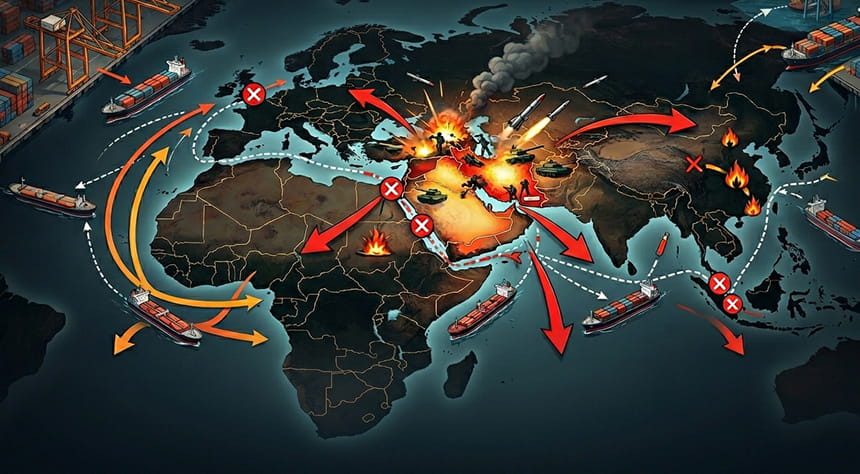
The escalating West Asian conflict in early 2026, involving Iran, Israel, and the United States, has triggered one of the most severe global supply chain disruptions in recent history. Strategic chokepoints such as the Strait of Hormuz, the Red Sea, and the Suez Canal have been destabilized, forcing rerouting of vessels and significantly increasing transit time, freight costs, and insurance premiums.
Nine key West Asian economies—Iran, Iraq, Israel, Saudi Arabia, United Arab Emirates, Qatar, Kuwait, Bahrain, and Oman—have reported damage to over 40 energy assets, including refineries and pipelines. Major producers like Iraq, Saudi Arabia, UAE, Kuwait, and Qatar have reduced oil output by nearly 10%, creating an unprecedented energy supply shock.
Countries dependent on these energy flows are facing acute consequences. India, which sources over half its crude from the region, is experiencing shortages affecting firms like Petronet LNG and GAIL. Similarly, Germany, Italy, and China are witnessing industrial slowdowns due to disrupted inputs.
Globally, aviation, automotive, and petrochemical sectors are under stress from fuel price spikes, while trade flows—especially in textiles, pharmaceuticals, and semiconductors—face delays due to airport closures across Gulf nations. In response, the International Energy Agency has released strategic reserves, while countries like India are diversifying sourcing and accelerating nearshoring strategies to enhance supply chain resilience.